
Thursday, November 12, 2026 The OT Team at Physio Inq
In this article
Summary
- Physiotherapists are trained in the structure and function of the body and its movement.
- Occupational therapists help people take part in the daily activities, or “occupations”, that matter to them.
- Under the NDIS, both are therapy supports, which are stated supports in your plan.
- Many participants see both, and the two often work on different parts of the same goal.
- The NDIS doesn’t “approve” individual therapists, but both must be AHPRA-registered.
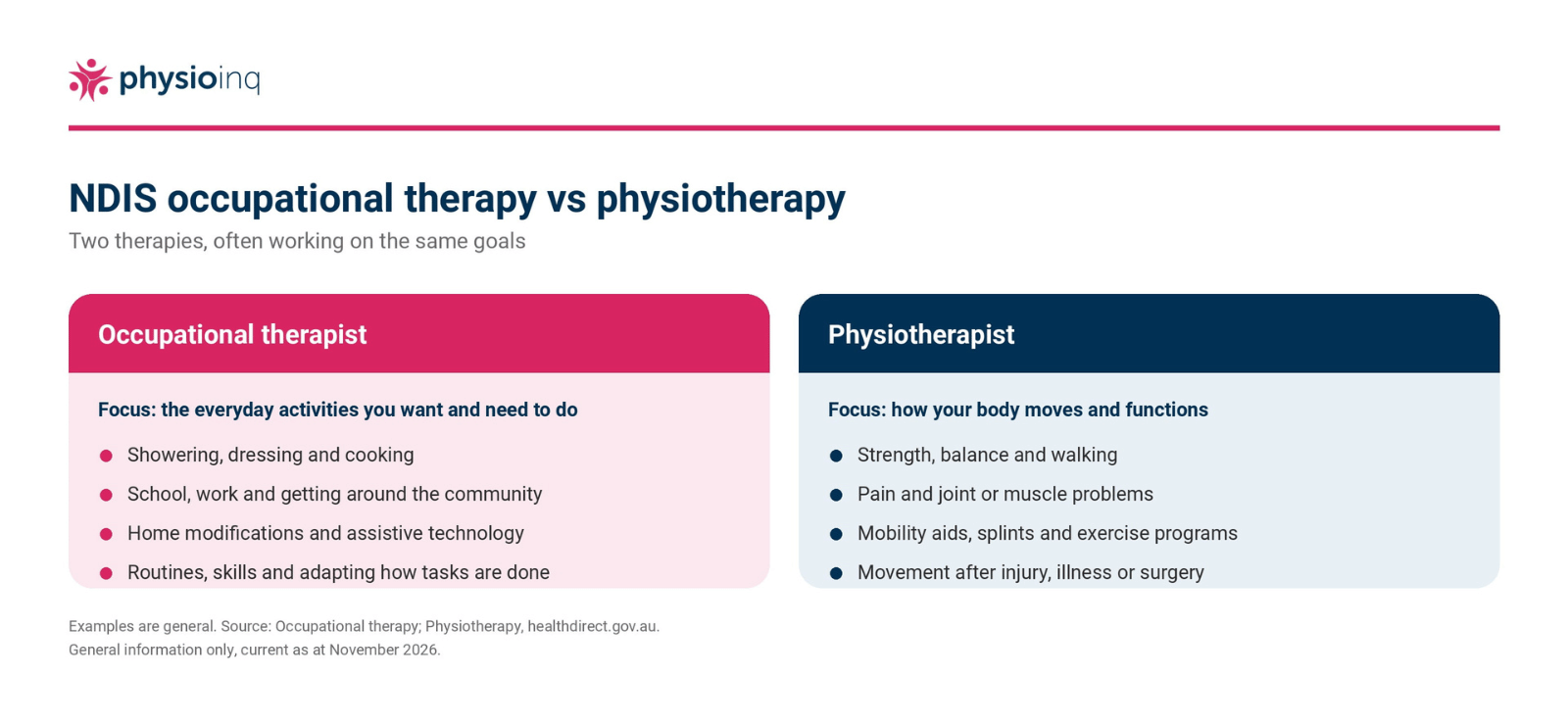
Under the NDIS, a physiotherapist focuses on how your body moves, such as strength, balance, walking and pain, while an occupational therapist focuses on the everyday activities you want to do, like showering, cooking, school or work. Many NDIS participants see both, with each therapist working on different parts of the same plan goals.
What’s the Difference Between an NDIS Occupational Therapist and a Physiotherapist?
The main difference is what each therapy targets: physiotherapy focuses on how your body moves, while occupational therapy focuses on the everyday activities you want to do.
A simple way to think about it: a physio helps your body do the movement, and an OT helps you do the activity.
Take getting in and out of the shower as an example. A physio might work on leg strength and balance so you can step in safely. An OT might look at the bathroom set-up, recommend a shower chair or grab rail, and help you find an easier routine.
When to see an NDIS physiotherapist
An NDIS physiotherapist is a good fit when the main barrier is physical: weakness, poor balance, stiffness, pain, or difficulty walking or transferring. Physiotherapists may also help with aids such as splints or crutches. Learn more about the NDIS physiotherapy services provided by Physio Inq physios.
When to see an NDIS occupational therapist
An NDIS occupational therapist is a good fit when the barrier is doing an everyday task, whether that’s self-care, cooking, managing a routine, getting to work or school, or using your home safely. OTs also assess for assistive technology and home modifications. Learn more about NDIS occupational therapy supports and services provided by Physio Inq OTs.
Is There Such a Thing as an NDIS Approved Occupational Therapist?
Not exactly. The NDIS doesn’t approve individual therapists.
Instead, therapy supports must be evidence-based and delivered by qualified allied health professionals who are AHPRA-registered or accredited by a relevant peak body. You can check any OT or physio on AHPRA’s public Register of practitioners.
What people often mean by “NDIS approved” is an NDIS-registered provider. If your plan is NDIA-managed, you must use a registered provider. If it’s self-managed or plan-managed, you can usually choose registered or unregistered providers.
You can check a provider’s registration on the NDIS Commission’s Provider Register.
Physio Inq is a registered NDIS provider, with AHPRA-registered occupational therapists and physiotherapists working with self-managed, plan-managed and NDIA-managed participants.
How do Occupational Therapy and Physiotherapy Coordinate Under an NDIS Plan?
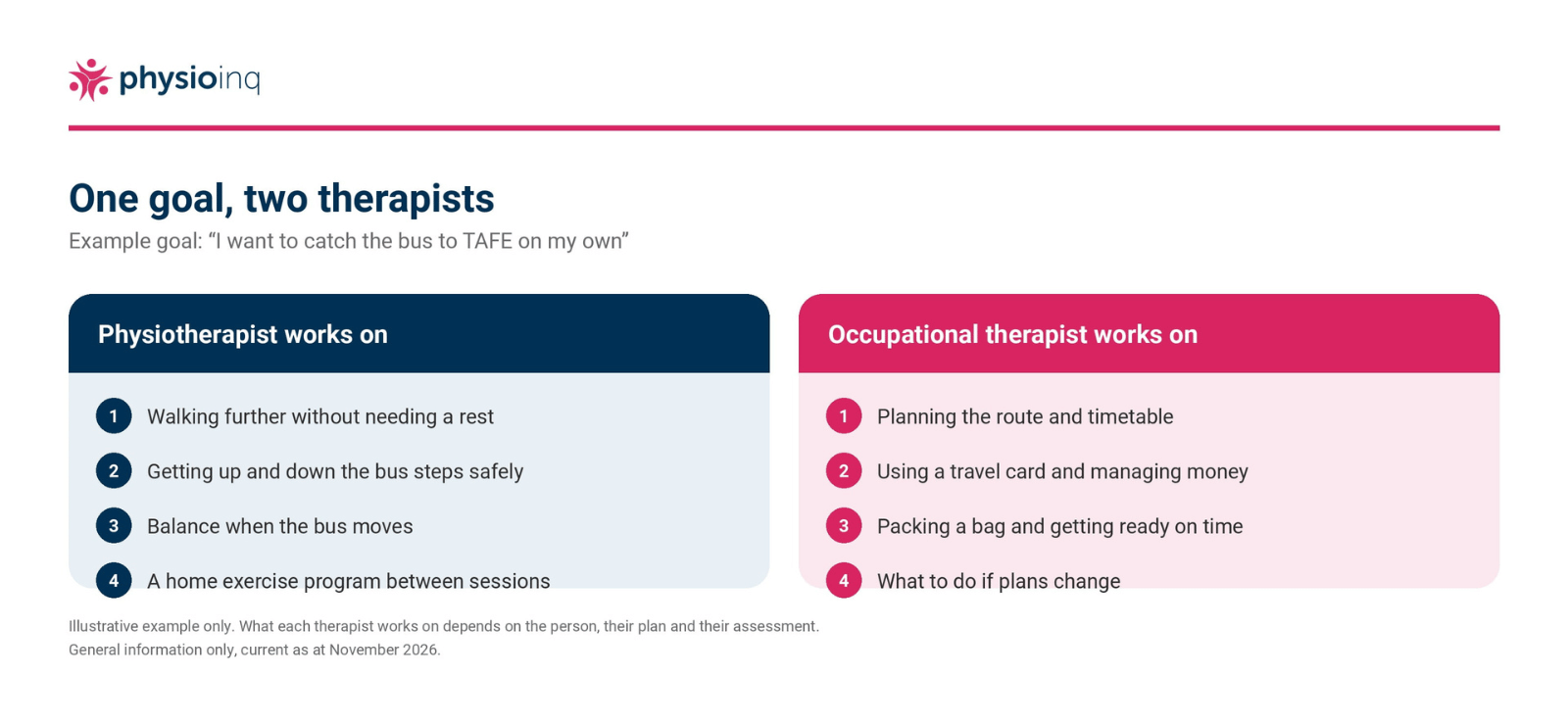
Occupational therapy and physiotherapy coordinate under an NDIS plan by working towards the same goals in your plan, each from their own angle, and keeping each other informed with your consent.
In practice, good coordination might look like:
- both therapists using the goals in your plan as the starting point
- sharing assessment findings, so you don’t repeat the same story twice
- the occasional joint visit for tasks that need both, like a tricky transfer
- reports that line up, so the NDIA sees a clear picture of your progress.
That last point matters at plan reassessment. NDIS guidance asks providers to write reports. that describe progress towards goals and recommend supports, and to share them with the participant first. When an OT and physio work together, their reports tend to tell one consistent story. If your needs change significantly, a functional capacity assessment can also bring the picture together.
How funding works
Therapy supports are stated supports, so the funding in your plan is set aside for the therapy described. Your plan may list therapy as one amount or separately, so it’s worth agreeing with each provider how many sessions they’ll use, so both therapies fit within your budget.
Our guide to the Improved Daily Living category under the NDIS explains how therapy funding works in more detail.
Don't have an NDIS plan yet? Our guide to NDIS eligibility and how to apply walks you through the first steps.
What to Expect in an NDIS Physio Session Aimed at Occupational Goals?
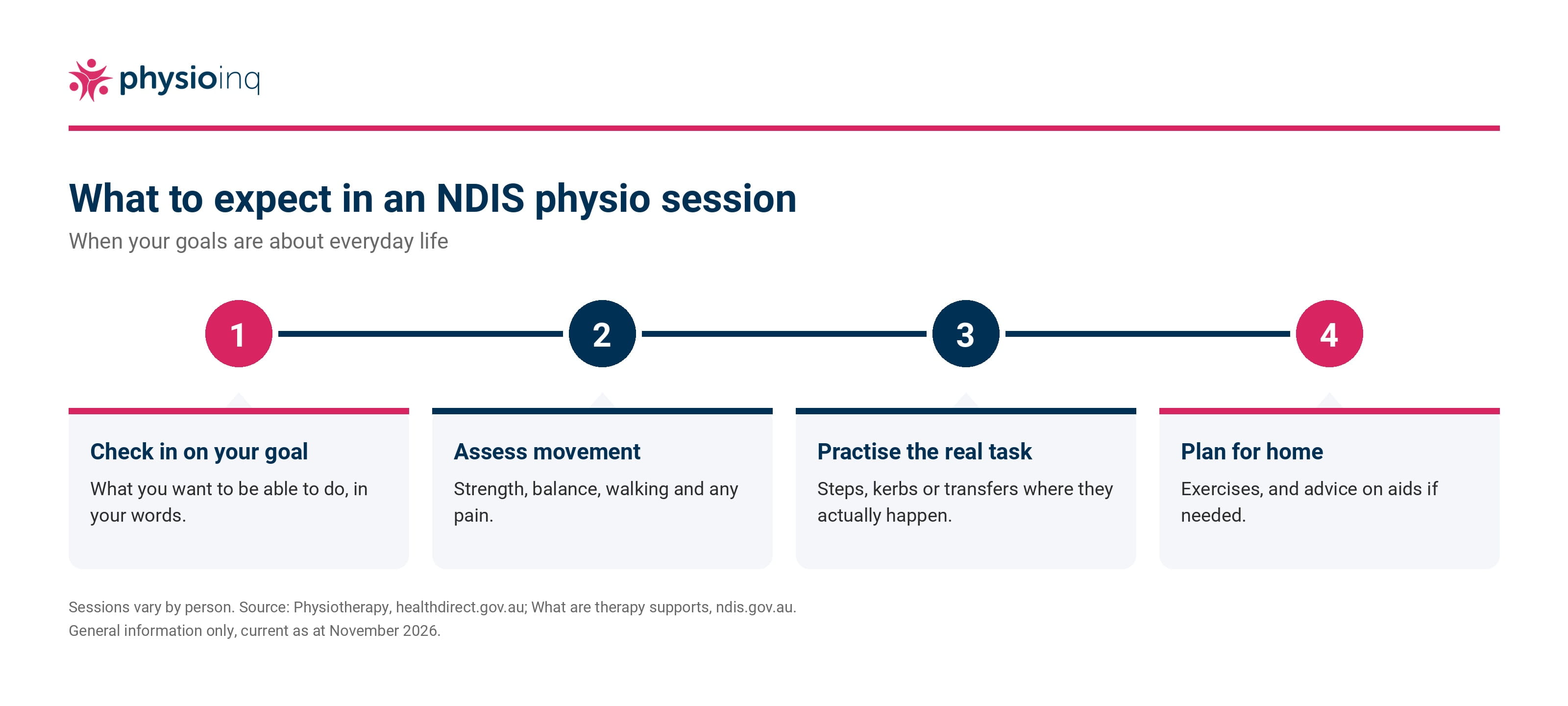
In an NDIS physio session aimed at everyday goals, expect the physiotherapist to start with what you want to be able to do, assess the movement that’s getting in the way, then practise the real task where it happens.
- Check in on your goal. For example, getting to the letterbox, playing with your kids at the park, or catching the bus.
- Assess movement. Strength, balance, walking, endurance and any pain.
- Practise the real task. Steps, kerbs, transfers or getting on the floor and back up, ideally where they happen in daily life.
- Plan for home. A short exercise program, and advice on aids if needed.
Because Physio Inq’s therapists come to your home, practice happens on your own steps, in your own bathroom and on your local footpath, rather than in a clinic.
The NDIS can also fund therapists to train family or carers, which can be useful when a physio shows someone how to help safely with a transfer or exercise.
Final Thoughts
Most everyday goals involve both movement and the activity itself, which is why OT and physio often work best side by side.