Make an Appointment
If your children are participating in sports, that’s surely a positive sign. They’re gaining social skills and physical fitness. However, if you are ignoring their complaints about injuries or body pain, this could possibly mean compromising their health and a potential sports career.
Here, we’re talking all about sport injuries among children, how to reduce risk of injury for children during sport, and ways a physiotherapist can help.
More Articles Related to Sport
Causes of Children’s Sport Injuries
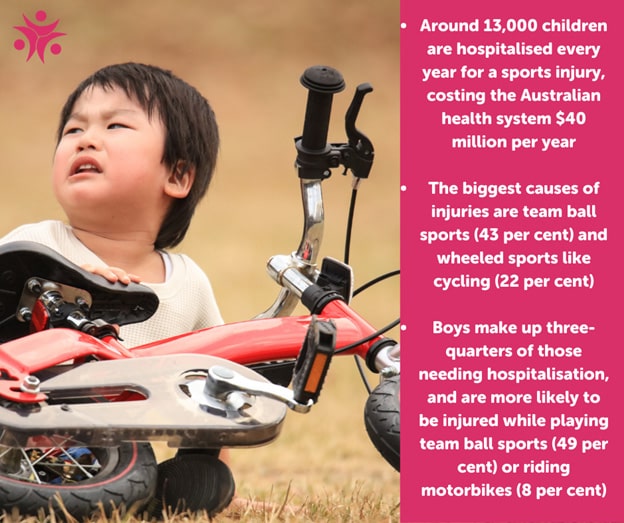
Over recent years, the frequency and intensity of injuries amongst children who participate in sports have increased exponentially. This has been attributed mostly to the increasing pressure on kids to participate in multiple sports or to even specialize in a single sport at a very early age.
But because children are undergoing continuous growth of their bones, ligaments, muscles, and tendons, these bodily changes make them more vulnerable to injuries.
In the areas surrounding growth plates where the bone and cartilage growth occurs, the nearby tendons and ligaments are weaker and more sensitive.
So, what may only be a sprain or bruise in adults could turn out to be a serious growth plate injury in younger athletes. For this reason, injury prevention for children is doubly important.
Remember that it’s not necessary for young athletes to go through severe pain to grow and toughen up; a presumption that’s still famous with many coaches.
Types of Sport Injuries in Children
Usually, sport-related injuries in children are of two types:
- Overuse or micro-injuries resulting from repetitive trauma to the body
- Acute injuries referring to a one-off event that leads to serious damage, thus putting a child on the sideline for a very long time
- Reinjuries where a past injury is re-inflamed
Overuse injuries can be caused by:
- Growth spurts
- Strength imbalances
- Inadequate warm-ups and cool-downs
- Excessive activity
- Playing year-round sports or multiple seasonal sports
- Poor technique
- Ill-fitting or unsuitable gear and equipment
Acute injuries can be caused by:
- Unsuitable gear and equipment
- Not enough emphasis on fair play
- Poorly maintained play areas (divots and holes on the field)
Reinjuries can be caused by:
- Returning to play before an injury has healed completely
- Sudden exertion after an injury versus gradually returning to play
- Making the same mistakes that caused the previous injury
Common Children Sport Injuries
To properly avoid sport injuries among children, the best thing to do is to first understand which injuries are the most common.
More Articles Related to Shoulder


Common overuse injuries include:
- Anterior Knee Pain: A common knee injury where the pain is experienced behind the kneecap due to inflammation of the tendon and cartilage causing tightness in the hamstring and quads.
- Little League Elbow: Pain and soreness in the elbow due to excessive throwing motion that causes an inability to flex and extend the elbow, reducing the effectiveness of a throw or pitch.
- Swimmer’s Shoulder: Inflammation and pain in the back of the shoulder caused by repetitive overhead stress on the joint from either swimming or throwing.
- Shin Splints: Pain in the front of the lower leg caused by excessive running on a hard, unforgiving surface.
- Spondylolysis: Lower back pain caused by excessive strain and overextension on the lower back, often seen in children who participate in soccer, football, weight lifting, gymnastics, wrestling, and diving.
Common acute injuries include:
- Eye injuries including scratched corneas, detached retinas, and burst blood vessels in the eyes
- Broken bones (fractures)
- Concussions
- Cuts, scratches, and bruises
Emotional Injuries of Sport in Children
While sports are an amazing way to boost your child’s self-esteem and overall confidence, competitive sport can also increase their stress and anxiety. The pressure to win and harsh judgements from coaches can sometimes backfire causing emotional injury.
To avoid emotional injuries in your kids during sport, the following tips can help:
- Don’t force a sport. Instead, listen to your child and push them only to their appropriate edge. It’s a fine line between encouraging your child to rise to the occasion and forcing them to do something they’re not interested in.
- Encourage healthy practice among their friends or join in yourself. Finding healthy ways to keep your child fit and in sport shape is key.
- Constructive criticism is one thing but outright bullying is another. Make sure your child isn’t being emotionally abused. Their coaches and peers should encourage them, not berate them.
- Ask for club recommendations from trusted family and friends to ensure your child is participating in a friendly and safe sport environment.
- Praise your child for a job well done and help your child learn from mistakes when they make one. When a kid loses, they know it and they’re probably already feeling badly enough. So, as a parent, be encouraging and don’t rub it in. Try to find what can be done better next time while noticing improvements.
- Lead by example and stay active and fit or simply by being genuinely engaged. Show up to the games and practise with them. It’s a great way to bond and will ensure your child enjoys their sport that much more.
More Articles Related to Paediatric Physiotherapy

Risk Factors for Sport Injuries in Children
Now that we know what the most common injuries among sports-playing children are, as well as their causes, we should look into the more specific risk factors for most sport injuries in children. These include:
- Not enough time off between seasons and not enough breaks during games
- Ill-fitting gear and poorly maintained fields
- Cross-training is not implemented
- Too much focus on winning and not enough focus on proper technique
- Poor hydration on hot days and poorly air-conditioned indoor play areas
How to Reduce Risk of Injury for Children During Sport
To avoid sport injuries in your children, the best thing to do is to create a safer environment all around. Essentially, avoiding or counteracting the risk factors for the most common children’s sport injuries is the best way to keep your kids as injury-free as possible.
Our suggestions to parents for their children while playing sport include:
- Advise your kids to never participate in sports if they are feeling pain or injury. Kids need to be in great physical condition to avoid making it to the sports field with undiagnosed injuries.
- It’s important to abide by the rules of a game to avoid any conflicts with the opposition. Also, respecting each other during play could mean lesser chances of outside-the-game injuries.
- Learn to use and wear protective gear as it could largely reduce the chances of injuries.
- Tell your kids to learn using the sports equipment correctly. This would allow them to perform better.
- Active stretching and warming up minimise the risk of getting injuries during the game.
- Kids should know the difference between exceeding their threshold levels and overtraining. Proper recovery is very essential to keep up with the prevalent fast pace of sports.
- During off-season days, encourage your kids to participate in other sports and athletics that could help them condition their bodies more effectively.
- Have a musculoskeletal pre-season screening for your kids to avoid them from harming their bodies prior to a season.
- Tell your kids that rest is the best form of recovery, and if there is a way to reduce the discomfort resulting from an injury, the intensity of training has to be reduced down.
- Get your child checked up regularly by a Physiotherapist, and start taking their mild injuries seriously.
How to Treat Children’s Sport Injuries
Even when avoiding the risk factors associated with most children’s sport injuries, things happen and kids get hurt while playing sports. In general, when it comes to treating sports injuries in children, it’s always better to be safe than sorry.
It’s important that someone in the club has an understanding of first aid for the moment when a child gets injured. Then, especially in the case of acute injuries, medical attention should be sought straight away.
On the other hand, overuse injuries tend to come on more slowly and can be more difficult to diagnose. If your child complains to nagging pains, bring them to a physiotherapist to work with them on not only treating the injury, but also preventing further issues.
A physiotherapist can properly diagnose your child’s injury, set up a treatment plan for the fastest recover possible, and offer a personalised exercise program to strengthen and lengthen any problem areas in the body to avoid future injuries as well.
Our sports physiotherapists have an understanding of many popular sports. This knowledge can help your child continue to play the sports they love with a lower risk of injury.
Sports Physiotherapy for Children
Our experienced physiotherapists can help your children with an accurate examination of their physical health. Our multidisciplinary clinic opts for a unified approach with an easy and minimalistic procedure.
Contact Physio Inq today and come to see us at one of our convenient clinics. Or let our mobile physio services come to you.
Whether your child is complaining of a sore elbow or they’re recovering from a bad sprain, our sports physiotherapist can help them get back in the game in no time.
Additional Resources
- Why Are Sports Important for Children’s Development?
- Children and Sports | When Is Too Young To Start?
Date Published: Tuesday, March 23, 2021
More Articles Related to Sport
More Articles Related to Shoulder
More Articles Related to Paediatrics


More Articles Related to Legs

More Articles Related to Knee
More Articles Related to Fitness




Locate a Paediatric Physiotherapy
Service Near me
Get the experience & convinence you deserve to support your or a loved one's allied health needs.
Our Paediatric Physiotherapy team are currently serving & taking appointments in the following states and regions in Australia:
New South Wales
- Blacktown
- Blue Mountains
- Campbelltown And Macarthur
- Canterbury-Bankstown
- Eastern Suburbs Sydney
- Georges River
- Hawkesbury
- Inner East Sydney
- Inner West Sydney
- Lake Macquarie
- Lower North Shore
- Newcastle
- Northern Beaches
- North Sydney
- Parramatta
- Penrith
- South West Sydney
- Sutherland Shire
- Sydney CBD
- The Hills Shire
- Upper North Shore
- Waverley
- Wollongong
Tasmania
Victoria
Need to get into direct contact with our Client Services team? We're all ears. Call our team directly on 1300 731 733